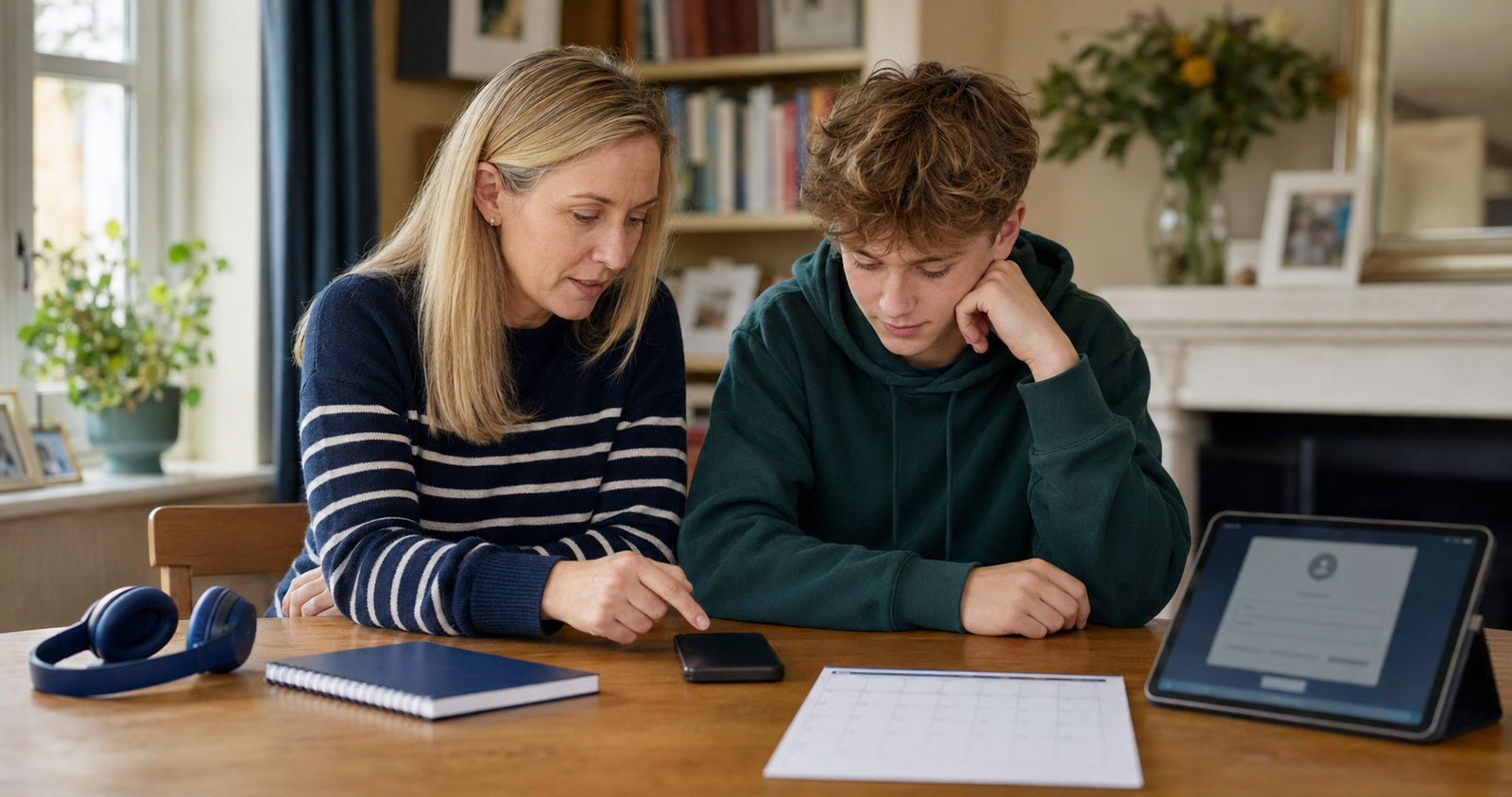

A 14-year-old asks for Instagram because nearly everyone in their class has it.
The parent has concerns. They have read about endless scrolling, sleep disruption, strangers sending messages and algorithms pushing increasingly engaging content. They would prefer to wait.
Then comes the argument that makes individual parenting unusually difficult:
“But everyone else is already there.”
This is one reason the debate over a social media ban for children under 16 is no longer only about screen time. It is also about collective pressure.
A parent can decide that their child is not ready for a particular platform. What they cannot easily decide is whether their child’s entire friendship group moves there anyway.
Governments in Australia and the United Kingdom are now trying to change that social baseline. Australia began enforcing under-16 account restrictions on major social platforms on December 10, 2025. In June 2026, the UK government announced that it would introduce its own under-16 social-media ban, with protections expected to begin in spring 2027.
That turns what once sounded like a hypothetical parenting question into a real policy experiment.
But it also raises a harder question.
If the problems come from addictive design, harmful recommendations, strangers, social comparison and weak safety controls, should the solution be to exclude children from social media entirely—or force social media to become different for children?
A Ban Solves a Problem Parents Cannot Solve Alone
Imagine two families.
Both have 13-year-olds.
The first family allows social media.
The second does not.
If only a handful of classmates use social platforms, the second child may lose very little by waiting.
Now imagine almost every friend, school-group joke, weekend plan and social conversation begins moving through those platforms.
The parental decision has changed.
It is no longer simply:
“Do I think this app is healthy?”
It becomes:
“How much social exclusion am I willing to impose in order to avoid it?”
That is an important argument for a legal minimum age.
A society-wide rule changes the coordination problem. If most children below the same age cannot hold accounts, parents no longer have to negotiate against the claim that everyone else’s parents said yes.
The law can create a common starting point.
This is one reason age limits appeal even to parents who normally prefer family decisions over government rules. A restriction does something parental controls cannot: it changes what other families and platforms are expected to do as well.
But “Social Media” Is Not One Thing
The phrase social media ban sounds much cleaner than the technology it tries to regulate.
Is YouTube social media?
What about Reddit?
Discord?
WhatsApp?
Roblox?
Pinterest?
A school discussion platform?
A gaming service where children can message strangers?
Australia’s current rules demonstrate how quickly the simple label becomes complicated.
As of April 2026, Australia’s eSafety Commissioner lists Facebook, Instagram, Kick, Reddit, Snapchat, Threads, TikTok, Twitch, X and YouTube among the services required to take reasonable steps to prevent under-16s from holding accounts.
But services currently outside the age-restricted category include WhatsApp, Discord, Roblox, Pinterest, Messenger, Steam, Google Classroom and YouTube Kids, among others. The list can change as services and their features change.
See the Australian eSafety Commissioner’s current social-media age restrictions
This reveals the first major policy problem.
If the danger is simply “social media,” drawing a line should be easy.
If the danger depends partly on which features a service contains, the line becomes much harder.
A private messaging service and a public recommendation feed may both connect people digitally while creating very different risks.
Perhaps the Real Product Being Regulated Is the Feed
Consider two hypothetical platforms.
Platform A
A teenager follows ten school friends.
Posts appear chronologically.
There are no public follower counts.
No recommended strangers.
No autoplay.
No endless feed.
No notifications after bedtime.
Only approved contacts can send messages.
Platform B
The same teenager opens the app.
An algorithm immediately begins selecting videos based on every pause, like and replay.
The feed never ends.
Popular posts display enormous engagement numbers.
Strangers can be recommended.
Notifications repeatedly pull the teenager back.
The system learns what holds attention and continuously adjusts.
Both are technically social networks.
Psychologically, they are different environments.
This matters because the American Psychological Association does not describe adolescent social-media use as inherently harmful in every case. Its guidance says effects depend on the young person, their circumstances, the content they encounter and the particular functions of the platform. The APA specifically highlights features such as recommended content, likes, endless scrolling and unrestricted notifications as areas requiring developmentally appropriate design and safeguards.
Read the APA health advisory on adolescent social-media use
That suggests an alternative way of framing the debate.
Perhaps policymakers are not really trying to keep children away from digital communication.
Perhaps they are trying to keep children away from a particular attention economy built around recommendation, engagement and prolonged use.
Why 16?
Every age law eventually produces an uncomfortable birthday.
At 15 years and 364 days, access is prohibited.
A day later, it becomes permitted.
Human development obviously does not work that way.
A particularly mature 15-year-old may manage online risks better than an impulsive 17-year-old. Children differ in judgment, self-control, family circumstances and digital experience.
The APA’s guidance makes a similar point: adolescent development is gradual, and there is no evidence showing that young people suddenly become immune to social-media risks at one precise age.
So why use an age at all?
Because law often needs administrable boundaries even where biology provides none.
Driving ages work this way.
Voting ages work this way.
Minimum ages for certain contracts, substances and activities work this way.
The policy question is therefore not whether every 16-year-old is magically ready.
It is whether 16 is a defensible point at which the benefits of a common rule outweigh the unfairness created by individual differences.
That is a much more difficult judgment.
The UK Is Already Trying to Solve the “Cliff Edge”
The United Kingdom’s 2026 approach is interesting because it does not simply propose an under-16 ban and then assume everyone becomes a fully independent digital adult at 16.
The government announced additional default protections for 16- and 17-year-olds.
Its July 2026 plans include social-media access being restricted by default between midnight and 6 a.m., overnight push notifications being muted, and personalized feeds and autoplay being switched off by default. Users aged 16 and 17 would be able to change those settings.
That creates something closer to a staircase than a cliff.
Under 16: strong access restrictions.
Ages 16–17: access, but with safer defaults.
Adulthood: wider choice.
Whether that system works remains to be seen, but the structure recognizes something psychologically sensible: independence can increase gradually.
The government is also targeting livestreaming and communication with strangers on some wider online services rather than treating every digital service identically.
This may become one of the most important lessons of the entire policy debate.
Age restrictions and safer product design do not have to be competing solutions.
They can be used together.
A Ban Could Give Children Something They Cannot Easily Choose Themselves
Adults often tell young people:
“Just spend less time online.”
That advice assumes the individual is making a decision in isolation.
But imagine being 14 and leaving the platform where most of your friends communicate, joke, post photographs and discuss what happened at school.
For an adult, deleting an app may mean losing entertainment.
For a teenager, it may feel closer to voluntarily leaving part of the peer environment.
This creates a strange problem.
A young person might personally prefer less social media while still finding it very difficult to leave.
A common restriction changes the cost.
If everyone in the age group faces similar rules, social life may adapt around the restriction rather than simply continuing without the one child whose parents said no.
That does not guarantee a better childhood.
Children can move to gaming, messaging and other digital services. Offline exclusion existed long before smartphones.
But collective rules can sometimes make an individually difficult choice easier.
The Case Against a Ban Is Stronger Than “Kids Need Entertainment”
Young people also gain real things from online communities.
A teenager interested in an unusual hobby may find people who share it.
A child in a geographically isolated area may maintain friendships.
Young people can share creative work, learn skills, participate in communities and obtain information that is unavailable in their immediate surroundings.
For some adolescents, online interaction may provide support they struggle to find locally.
The APA specifically notes that social-media experiences can be beneficial for some young people, including those seeking connection and support unavailable in their offline environment.
That makes blanket restrictions morally more complicated than banning a clearly unnecessary product.
A government is not merely removing entertainment.
It may also be restricting communication and community.
The strongest argument for a ban must therefore show not simply that social media can cause harm, but that those benefits can reasonably be preserved elsewhere while the highest-risk environments are delayed.
Children Themselves May Want Protection Without Wanting Exclusion
The UK’s 2026 consultation produced an interesting divide.
The government reported that 90% of participating parents supported a minimum social-media age of at least 16.
Among the children and young people consulted, support for a universal age-16 restriction was much lower: only 19% supported a minimum age of 16 across all social-media platforms.
Yet young participants were considerably more supportive of restrictions on particular platforms and engagement features. For example, 53% supported restricting infinite scrolling.
These consultation figures should not be treated as a representative national opinion poll; people chose whether to participate.
But the contrast is still revealing.
Adults may frame the problem as:
Should children be allowed on social media?
Young people may be more inclined to ask:
Why can’t the social media we use simply be less aggressive?
Those are not identical questions.
The Age-Verification Problem Cannot Be Waved Away
A rule stating “under-16s cannot have accounts” is easy to write.
Knowing who is under 16 is harder.
For years, many platforms effectively relied on users entering a birth date.
A child who encountered:
Date of birth?
could simply become 18 in a few seconds.
A serious age restriction needs something stronger.
Australia’s current system expects platforms to take reasonable steps rather than relying solely on self-declared birth dates. Depending on the platform and account, age assurance can involve combinations of existing account information and other age-related signals. The eSafety Commissioner says platforms should also have review mechanisms when users are incorrectly classified.
Importantly, Australia does not require every adult to automatically upload identification simply to use social media. Platforms may rely on other reliable information where appropriate.
Still, the privacy trade-off is real.
A platform attempting to determine whether somebody is 14, 17 or 35 may need more information than one that simply accepts whatever age the user types.
That creates an uncomfortable possibility:
A law intended to reduce children’s exposure to digital surveillance could encourage more sophisticated systems for estimating everyone’s age.
The related privacy question is explored more broadly in [Is Online Privacy Already Impossible?]. The age-ban debate makes that issue unusually concrete: how much information should people have to reveal in order to prove they are old enough to protect their privacy?
The Perfect Enforcement Test Would Kill Almost Every Useful Policy
Critics sometimes argue that teenagers will bypass age restrictions with false information, borrowed accounts, VPNs or new services.
Some certainly will.
But “some people will evade it” is not sufficient by itself to show that a rule is useless.
Teenagers sometimes obtain products they are legally too young to buy.
Drivers sometimes exceed speed limits.
People bypass website restrictions.
Laws are rarely judged by whether they eliminate a behaviour completely.
The useful question is whether they change the behaviour enough to justify their costs.
A restriction that reduces under-16 social-media participation substantially could still matter even if determined teenagers circumvent it.
On the other hand, a poorly designed ban that merely pushes children onto harder-to-monitor platforms could create the appearance of success while moving risk elsewhere.
That is why Australia is worth watching carefully.
The interesting evidence will not simply be how many accounts platforms delete.
It will be what young people do next.
The Displacement Problem Could Decide Whether Bans Work
Suppose TikTok, Instagram and Snapchat become inaccessible to 13-year-olds.
The teenagers do not suddenly lose their desire to communicate.
Where does that energy go?
Perhaps they spend more time with friends offline.
Perhaps group messaging becomes more important.
Perhaps gaming communities absorb more social interaction.
Perhaps a new platform emerges that falls outside the legal definition.
Perhaps children use parents’ accounts.
Perhaps some simply wait.
This is what policymakers need to measure.
A successful ban is not one that makes a particular app’s under-16 statistics fall.
It is one that produces a healthier overall digital environment.
That distinction matters because regulating platforms one by one can create a game of technological whack-a-mole.
Children’s social needs remain even when a product disappears.
Parents Still Matter Under a Government Ban
It would also be a mistake to treat legislation as a replacement for parenting.
A child eventually reaches 16.
Then 18.
They will encounter misinformation.
Manipulative advertising.
Sexual content.
Scams.
Public criticism.
Strangers.
Social comparison.
Pressure to stay online.
A law can postpone some exposure.
It cannot prepare someone for it.
The APA recommends not just restrictions but ongoing adult discussion, coaching and gradually increasing autonomy, particularly during early adolescence.
That suggests parents need two different strategies at once:
protection while children are less ready, and preparation for the point when protection ends.
The question of readiness appears even earlier when families decide what age a child should get their first smartphone.
Owning a phone and having unrestricted social-media accounts are not the same milestone.
A child may need calls, maps and family messaging years before they need an algorithmically personalized public feed.
Platforms Have Quietly Benefited From Making This a Parenting Problem
For years, discussions about children’s social-media use have often ended with advice to parents.
Set limits.
Check the phone.
Talk to your children.
Use parental controls.
Keep devices out of bedrooms.
Those can all be sensible.
But notice what this framing does.
It places much of the responsibility on a parent competing against products built by large companies with behavioral data, professional design teams and commercial incentives to keep users engaged.
A parent can tell a teenager to stop scrolling.
The platform controls whether the feed ever reaches an end.
A parent can tell a child not to obsess over popularity.
The platform decides whether follower counts, view counts and likes are constantly displayed.
A parent can say, “Don’t talk to strangers.”
The service decides how easily strangers can discover or contact young users.
This does not remove personal or parental responsibility.
It explains why platform design belongs in the policy discussion.
If a feature creates predictable risks for children, “parents should manage it better” cannot be the only answer available.
The Strongest Policy May Be the One That Makes the Ban Less Necessary
Imagine that social-media companies were required to offer children an entirely different product.
No personalized recommendation feed.
No infinite scrolling.
No overnight notifications.
Strong restrictions on adult strangers contacting minors.
More private defaults.
No targeted advertising based on behavioral profiling.
Clear daily stopping points.
Age-appropriate content controls.
Would a complete under-16 ban still be necessary?
Some people would say yes. The social pressures and risks would remain too great.
Others might consider that environment acceptable.
This thought experiment reveals the real disagreement.
Some supporters of bans believe children are not developmentally ready for social media itself.
Others are reacting to the version of social media companies currently choose to build.
Those are different arguments, and they point toward different long-term solutions.
So, Should There Be a Social Media Ban for Children Under 16?
There is a strong case for society establishing a period in which children are protected from the most aggressively engaging forms of social media.
Parents cannot solve network effects individually.
Voluntary platform age limits have been easy to bypass.
Commercial incentives do not always align naturally with children’s wellbeing.
Australia has therefore moved responsibility from children and parents toward platforms, while the UK is preparing to do something similar.
But the case for caution is also serious.
Not every platform creates equal risk.
Not every teenager has equal maturity.
Young people can lose valuable communities as well as harmful content.
Age assurance raises privacy questions.
Restrictions can displace activity rather than eliminate it.
And turning 16 does not suddenly make persuasive design harmless.
Perhaps the most promising idea emerging from current policy is therefore not the ban alone.
It is the recognition that access rules, safer defaults, feature restrictions, age-appropriate design and digital education can form different layers of protection.
The real success test will not be whether governments can announce that under-16s have been removed from particular apps.
It will be whether, several years from now, young people are sleeping better, encountering less harmful content, experiencing less unwanted contact, developing healthier digital habits—and still gaining the useful forms of connection technology can provide.
Anything less risks confusing a cleaner account-age statistic with a safer childhood.
Before You Vote, Choose What You Are Actually Banning
Imagine four possible policies:
A complete ban on major social-media accounts until 16.
Social media allowed, but personalized feeds, infinite scrolling, stranger contact and overnight notifications disabled for minors.
Parental approval required before an under-16 account can be created.
No legal age ban, but strict child-safety rules imposed on platforms.
Which one would you choose if only one could become law?
And if you support a ban, what would convince you that a redesigned platform had become safe enough for younger teenagers?
If you oppose one, which specific feature or risk do you think governments should target instead?
Cast your vote, then explain where you believe responsibility should sit: primarily with parents, young users, technology companies or government.
That answer may reveal more than a simple yes or no.
The Quirky Minds polls reflect the opinions of participating readers. They are informal reader polls and should not be interpreted as scientific surveys, medical guidance or individual parenting advice.