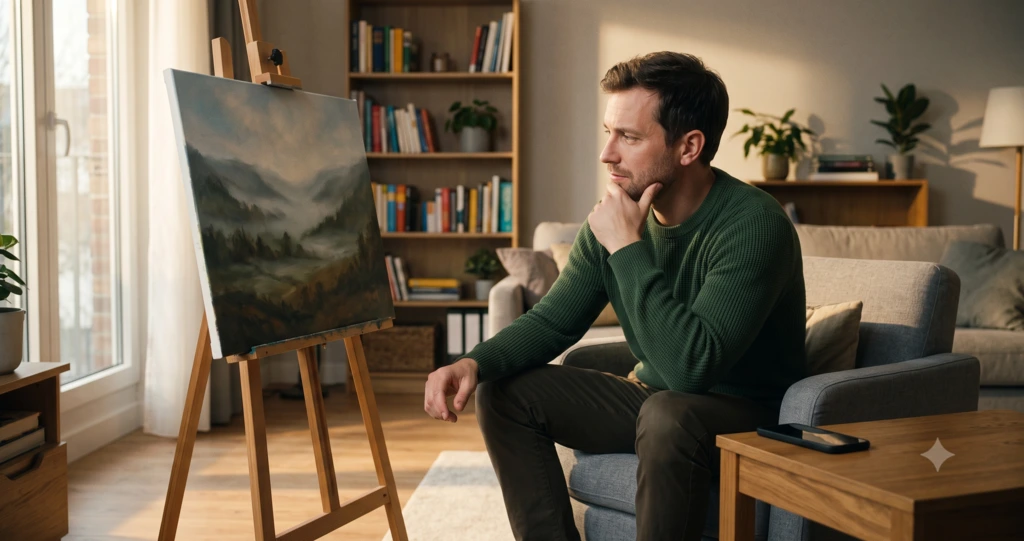

Your phone is face down on the table.
You have just done something that mattered to you. Perhaps you passed an exam after months of work, finished your first 10K, paid off a debt, built something with your own hands or received good news you had been waiting for.
Nobody online knows yet.
There is no photograph, caption, reaction count or congratulatory comment. For a little while, the achievement exists only in your actual life.
How does it feel?
That question gets at something more interesting than whether people post too much. Human beings have always shared good news, displayed achievements and wanted recognition from people around them. Social media did not invent the desire to be seen.
What it changed was the availability of an audience.
An ordinary person can now announce a meal, purchase, relationship milestone, holiday, opinion, fitness result or career change to hundreds or thousands of people within seconds. Over time, that audience may stop being something we encounter after an experience. We can begin imagining it beforehand.
And once the audience arrives before the moment, it may have a vote in what the moment should look like.
The Audience Can Arrive Before the Post
Suppose you are choosing between two restaurants.
One serves the food you genuinely prefer. The other is newer, more fashionable and has an interior that will look excellent in photographs.
Choosing the second restaurant does not prove you are obsessed with social media. Maybe you like both. Maybe your friends want to go there.
But imagine the same calculation spreading quietly across different parts of life.
Which hotel will look better?
Which clothes will photograph better?
Which gym result is worth announcing?
Is this weekend interesting enough for a story?
Should we take another photograph because the first one doesn’t make the evening look quite as good as it felt?
The important shift is subtle. You are no longer only experiencing something and later deciding whether to share it. Part of you is viewing the experience from outside while it is happening.
That imaginary observer can become a kind of silent companion.
A beautiful view is still a beautiful view, but another question appears beside it: How will this look?
A promotion is still professionally valuable, but another question appears: What will people think when they see it?
A relationship can be genuinely happy while still developing a public-facing version of itself.
The concern is not that these experiences become fake. Something more complicated can happen: real experiences can begin serving two audiences at once — the person living them and the people expected to see them later.
Those audiences do not always want the same thing.
Wanting to Be Seen Is Not the Same as Needing to Perform
It would be easy to turn this discussion into a lecture about seeking validation. That would miss a large part of why people share their lives.
Imagine getting engaged and refusing to tell anyone because the happiness should supposedly be “enough on its own.” Or graduating and deciding that inviting family would somehow make the achievement less authentic.
That would be an odd standard for human life.
Celebration has always involved witnesses. We tell stories, show photographs, call relatives and gather people around important events because shared emotion can make an experience richer.
Online sharing can serve that same purpose.
A 2025 Scientific Reports study examined life-event disclosures using Facebook data from 236 participants. Its quasi-experimental analysis found improvements in several measures of well-being following some disclosures, with particularly strong effects around negative life events. The researchers also found that responses from other people appeared relevant, suggesting that posting can sometimes function as a route to social support rather than merely self-promotion. The study concerns a particular sample and platform, so it should not be treated as proof that sharing helps everyone, but it is a useful reminder that online disclosure can have genuine social value. Read the study in Scientific Reports.
There is an important difference between saying:
I want people I care about to share this moment with me.
and feeling:
This moment will not fully count unless people respond to it.
From outside, both situations may produce exactly the same Instagram post.
The difference is happening inside the person who posts it.
A Good Experience Can Acquire a Second Score
Consider a smaller event.
You cook something you are genuinely pleased with and post a photograph. Normally, your posts receive plenty of reactions. This one receives almost none.
Has the food changed?
Obviously not.
But your feeling about the evening might.
Perhaps the photograph suddenly seems less impressive. You wonder whether posting it was embarrassing. Something that pleased you twenty minutes earlier now feels ordinary because other people did not appear sufficiently interested.
The experience has acquired a second measurement.
There is the private score: Did I enjoy this? Am I pleased with what I made?
Then there is the public score: How did it perform?
Social platforms make that second score unusually visible. Attention that once arrived through smiles, conversations or compliments can now appear as numbers beneath an event.
Those numbers measure something real — engagement — but engagement and personal significance are not the same unit.
A child’s handmade birthday card may matter enormously to one parent and mean almost nothing to an online audience. A carefully developed professional skill may attract little attention while a casual photograph unexpectedly travels far beyond its usual audience.
The strange psychological risk is not simply wanting likes. It is allowing the measurable reaction to become evidence about something the reaction was never designed to measure.
Popularity can tell you how a post performed. It cannot reliably tell you how valuable the underlying experience was.
The Public Version of You Is Always Edited
There is another reason online pride can become complicated.
A profile cannot contain a complete person.
Even someone determined to be authentic still selects. You choose one photograph rather than twenty others. You explain one opinion but leave out the uncertainty behind it. You announce that you got the job without documenting every rejected application that came before it.
Selection is not dishonesty. It is unavoidable.
But repeated selection can gradually produce a public character.
This person travels.
This person has a good relationship.
This person is progressing professionally.
This person is funny.
This person has beautiful children.
This person is politically informed.
This person is always busy.
Once that public character becomes familiar to an audience, maintaining consistency with it can create its own pressure.
What happens if your life changes?
If you have spent years posting fitness achievements, is gaining weight merely a private change or does it feel like a public failure?
If your relationship has become part of your online identity, does admitting that it ended feel more difficult?
If everyone knows you as successful, how easy is it to mention that work is going badly?
Research published in Nature Communications examined authentic and idealised self-expression online. In a large observational sample, more authentic online expression was associated with greater life satisfaction, and a smaller experimental component found better mood and positive affect when participants were encouraged to post more authentically rather than in a self-idealised way. The researchers also acknowledged important limits, including what could and could not be inferred from the observational part of their work. The original study is available here.
The finding does not mean that everyone should reveal more of their private life. Authenticity is not the same as total disclosure.
It does raise an interesting possibility: perhaps one source of strain is not being visible, but repeatedly having to live alongside a polished version of yourself that other people now expect to see.
Some Things Change When Nobody Will Ever Know
Imagine being offered a peculiar bargain.
For one year, you can still travel, buy things, exercise, learn, date, earn money, decorate your home and pursue whatever ambitions you choose. You can take photographs and keep every memory.
You can also tell people who are genuinely close to you.
The only restriction is that none of it can be publicly posted.
What changes?
The obvious answer might be “nothing.” You still want the career, relationship, health, experiences and possessions because they belong to your life.
For many things, that probably would be true.
Other desires may become less certain.
Would you pay as much for a logo nobody would ever see?
Would you choose the same hotel if nobody knew where you stayed?
Would you attend an event you did not particularly enjoy if there were no photographs afterwards?
Would the renovation need to resemble the homes you see online?
Would you still want exactly the same body, or would your actual priorities be strength, health, comfort or energy?
These are not tests of whether somebody is shallow.
Status has always influenced human choices. Clothes, homes, occupations, ceremonies and possessions communicated something about us centuries before anyone invented the news feed.
The thought experiment is useful because it separates two motives that can comfortably coexist:
the value of having something and the value of being seen having it.
Neither automatically cancels the other.
But knowing their proportions can change a decision.
Private Does Not Mean Unshared
There is also a misleading choice hidden inside conversations about online validation.
We often talk as though something must either be publicly posted or kept completely to ourselves.
Most human life falls somewhere between those extremes.
You can send the photograph to three friends.
Tell your parents.
Celebrate with your partner.
Show colleagues.
Put the picture in a family group.
Print it.
Keep it in your camera roll and rediscover it years later.
A moment can be witnessed without becoming public content.
That difference matters because the size of an audience and the importance of an audience are not the same thing.
Ten thousand strangers can know that you achieved something without knowing what it cost you. One friend who saw you struggle for six months may understand the achievement immediately.
In that sense, private pride does not necessarily mean becoming radically independent of other people’s opinions. Humans are social creatures, and being understood by the people we value can be deeply important.
The more revealing question is whose reaction has earned the right to influence how you feel about your life?
That is a much smaller group than everyone capable of viewing a post.
When Other People’s Lives Begin Editing Yours
Posting does not exist separately from scrolling.
The audience you imagine when sharing your life is partly made up of people whose lives you are also watching.
That creates a feedback loop.
You see someone’s holiday and begin thinking about travel.
Someone sees your new kitchen and thinks about renovating.
You see a friend’s promotion.
They see your relationship.
Another person sees both.
Nobody has to lie for the collective picture to become misleading.
This connects directly with the problem explored in Does Social Media Comparison Make People Feel Behind in Life?. A feed can combine different people’s most visible achievements into a standard that no single person actually meets.
Posting adds another layer: once we know what kinds of moments look impressive in other people’s feeds, we may become better at producing similar evidence from our own lives.
Then comparison is no longer only something happening to us.
It can quietly participate in what we choose to display, pursue or value.
That may explain why the question “Would I still want this if nobody could see it?” can feel surprisingly revealing.
Privacy Has a Psychological Value Too
Some experiences seem to gain something from being shared widely. Others seem to lose something.
A new business might benefit from publicity. A creative project may need an audience. A graduation can be joyful to announce.
But consider a private joke between two people. A goal you are working toward before telling anyone. An afternoon with your child that nobody photographs. A generous act the recipient never publicises. A relationship that does not need periodic proof.
Their privacy can become part of their meaning.
Nothing is waiting to be evaluated.
Nobody outside the moment needs to approve.
That does not make private experiences morally superior. Constantly hiding everything can create its own problems, and online privacy is itself much more complicated than simply deciding not to post; that broader issue is explored in Is Online Privacy Already Impossible?.
Still, there is something distinctive about possessing memories that were never asked to perform.
Look through your own camera roll and you may see it.
The most polished photographs might be the ones you posted. But the pictures that make you stop scrolling may be badly framed: someone laughing before they were ready, a pet asleep in a ridiculous position, an ordinary family meal, a screenshot of an old conversation, a blurry photograph from a day nobody else would recognise as important.
Those pictures did poorly online for a very simple reason.
They never entered the competition.
You Do Not Need to Quit Social Media to Find Out
The question in this poll is not really asking whether everyone should disappear from the internet.
Posting can connect people, preserve memories, find communities, build careers, share creativity and allow distant relatives or friends to participate in each other’s lives. Treating all of that as vanity would be as simplistic as assuming every post is meaningful self-expression.
A better experiment is much smaller.
Next time something good happens, notice the order in which the thoughts arrive.
What did you feel before imagining the post?
Who did you first want to tell?
Did you want people to share your happiness, or did you need their reaction to confirm that the event was impressive?
Would you make the same choice if it remained invisible?
And once you do post, does a weak response reduce your opinion of something you valued five minutes earlier?
There are no ideal answers to those questions. A person can genuinely enjoy an experience and enjoy displaying it. Pride and recognition are not mutually exclusive.
The useful information lies in noticing when the audience stops being a guest at the celebration and starts becoming a judge.
Would You Still Be Proud?
Perhaps private pride is not about reaching a state where nobody else’s opinion matters.
That sounds less like independence and more like a denial of how human relationships work.
The stronger test is whether your life retains value when the audience temporarily disappears.
Do the people you love still matter when nobody sees the photographs?
Does the achievement still count when the announcement receives little attention?
Is the holiday still worthwhile without proof that you went?
Would you continue improving at something if progress remained invisible for a year?
Would you still choose the same version of success?
If the answer is yes, posting may simply be a way of sharing a life that already has meaning.
If the answer changes dramatically, the post may be doing more than documenting the experience. The imagined audience may have become part of the reason for having it.
That does not require shame. It requires curiosity.
Because perhaps the most revealing moments in a life are not the ones nobody else can see.
They are the ones that would still matter if nobody else ever did.
Cast Your Vote
Would you still feel equally proud of your achievements and experiences if you could never post them publicly?
If your answer is yes, which parts of your life would you happily keep completely private?
If your answer is no, what would actually be missing: appreciation from people you love, social recognition, proof of success, the pleasure of sharing, or something else?
Vote for the answer closest to your experience. Then consider a harder question before leaving: which important part of your current life would you continue choosing exactly as it is if nobody online ever knew about it?
The Quirky Minds polls reflect the opinions of participating readers. They are informal reader polls and should not be interpreted as scientific surveys or mental-health assessments.