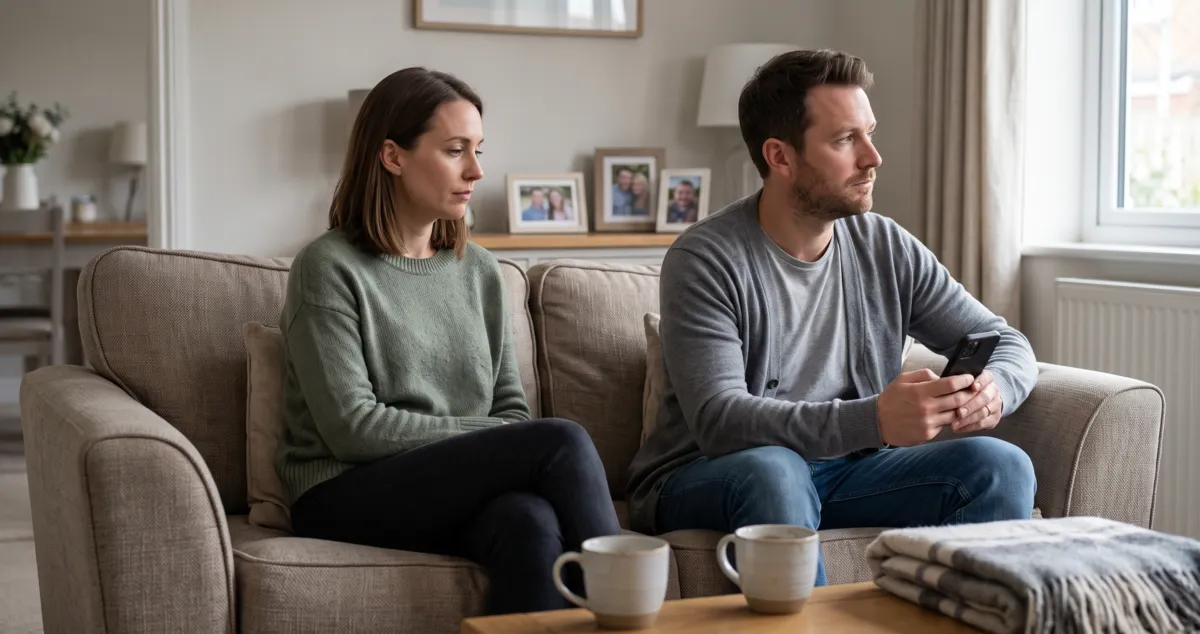

The television is on. Two mugs are sitting on the coffee table. Your partner is close enough that you could reach out and touch them.
But you have already decided not to tell them what happened today.
Maybe you tried yesterday and they barely looked up. Maybe every serious conversation somehow turns into an argument. Maybe nothing dramatic has happened at all; the relationship has simply become a place where schedules, groceries and bills are discussed more easily than fear, excitement, disappointment or affection.
From outside, you have company.
Inside the relationship, you may feel strangely alone.
Now picture a completely different evening. You unlock the door to an empty home. Nobody asks how your day went because nobody is there. You make dinner for one, spend the evening by yourself and go to bed without another person beside you.
Which situation is lonelier?
At first, it sounds like a contest between two kinds of sadness. Look more closely, though, and the question becomes more interesting. Being physically alone and feeling emotionally alone are not simply stronger and weaker versions of the same experience. They can hurt for different reasons.
An Empty Room and an Unresponsive Person Create Different Absences
Being alone is something you can often describe from the outside: one person, no immediate company.
Loneliness is harder to see.
The World Health Organization’s work on social connection distinguishes loneliness from social isolation. Loneliness concerns the painful gap between the social connection someone wants and what they feel they actually have, while social isolation is more about an objective lack of sufficient social ties.
That distinction explains why two apparently opposite situations can coexist.
Someone may live alone and have a week full of meaningful contact: lunch with a sibling, messages from old friends, a football club on Thursday, colleagues who notice when something is wrong, neighbours they genuinely know and a quiet Sunday they actually enjoy.
Another person may share a house with a partner and interact with them every day, yet gradually stop mentioning anything that matters.
The first person has more solitude.
The second may have more loneliness.
That does not make living alone easy, and it does not mean every quiet relationship is emotionally empty. It simply shows why counting the people in a room tells us surprisingly little about whether someone feels connected.
Loneliness Can Hurt More When Someone Was Supposed to Be There for You
There is a particular frustration in reaching for something that appears available but repeatedly turns out not to be.
Imagine receiving difficult news at work. If you live alone, you may wish there were somebody waiting at home who already knew the background and could listen.
Now imagine that person actually is waiting at home.
You begin explaining what happened. They keep scrolling on their phone. You try again later and get a distracted “Don’t worry about it.” Eventually you stop talking.
Both experiences contain an unmet need for connection, but the second contains something extra: expectation.
A close relationship usually creates a reasonable expectation that, at least sometimes, you will be noticed. Not perfectly understood. Not endlessly reassured. Just emotionally registered by the person whose life is closely joined to yours.
When that connection repeatedly fails to arrive, you are not only missing companionship. You may also be trying to understand why companionship that seems to exist on paper feels unavailable in practice.
That uncertainty can be exhausting.
People living alone generally know when they are alone. Someone who feels lonely inside a relationship may spend months wondering whether they have the right to call the experience loneliness at all.
Maybe I’m asking too much.
Maybe this is just what long relationships become.
Maybe they’re tired.
Maybe I’m too sensitive.
Maybe everybody lives like this after ten years.
Those questions can sometimes lead to useful perspective. A partner genuinely can be distracted, stressed, grieving, overwhelmed by work or exhausted by parenting.
But explanations can also become a way of avoiding a more concrete question:
When I reach for connection in this relationship, what usually happens?
That may reveal more than asking whether the relationship looks happy from the outside.
The Most Important Difference May Be Whether the Loneliness Was Chosen
We are sometimes too quick to treat time alone as a problem.
Imagine someone spending Saturday afternoon by themselves. They walk somewhere, make lunch, read for an hour, put music on and do absolutely nothing social until evening.
Are they lonely?
There is no way to know from the scene.
Research published in Scientific Reports in 2023 followed adults’ everyday experiences of solitude and social interaction. More time alone on a given day was associated with some costs, including greater loneliness and lower satisfaction, but it was also associated with lower stress and a stronger sense of autonomy. Crucially, some of the negative associations were reduced when solitude felt chosen rather than imposed. The researchers found no single ideal balance of solitude and social time that applied to everyone. The study is available here.
That difference between choosing and enduring solitude matters far beyond research.
“I finally have the house to myself tonight” and “There is nobody I can call tonight” may describe the same number of people in the room.
Psychologically, they are miles apart.
Solitude can offer privacy, freedom, rest and the rare pleasure of arranging an entire day without negotiation. But when a person desperately wants dependable companionship and cannot find it, empty evenings can lose all of those qualities. Weekends stretch. Illness feels more frightening. There is nobody automatically present for the small events that hardly seem important enough to telephone someone about.
Even good news can expose the absence.
Sometimes what people miss most is not conversation. It is having one particular person who would naturally be the first to know.
A Relationship Can Also Be Lonely Without Being a Bad Relationship
This distinction matters because the phrase “lonely relationship” can sound like a verdict.
It should not automatically be one.
Two people can become emotionally distant during a difficult period without losing the relationship underneath it. A new baby changes sleep, attention and intimacy. Bereavement can make somebody withdraw. Financial trouble can reduce conversations to logistics. Long working hours can turn partners into exhausted shift workers who happen to share a bedroom.
There is a difference between connection that has temporarily become difficult and connection that one or both people have largely stopped trying to provide.
Suppose a couple notices the distance.
One says, “We don’t really talk anymore.”
The other responds, “I’ve noticed it too.”
That conversation may be uncomfortable, but something important has happened: the problem now belongs to both people.
Compare it with a different response.
“You’re imagining things.”
“Nothing is ever enough for you.”
“Why do you always create problems?”
Those responses do not automatically tell us everything about a relationship, but they reveal a different obstacle. Now the couple is not merely dealing with disconnection; they may also be struggling to discuss the disconnection itself.
The condition of a relationship is therefore not measured only by whether loneliness appears.
A revealing measure is what happens after somebody admits that it has appeared.
Living Together Can Hide How Little Life Is Actually Being Shared
A couple can accumulate enormous amounts of time together without much emotional contact.
Wake up.
Get ready.
Take children to school.
Work.
Message about groceries.
Eat dinner.
Watch something.
Look at separate phones.
Sleep.
Repeat.
There may be no major conflict anywhere in that routine. There may even be affection.
Still, something can slowly disappear: curiosity.
You stop asking what the other person thinks because you assume you already know. They stop telling you minor stories because the response has become predictable. Neither person intentionally rejects the other, but both gradually become more informed about the practical operation of the household than about the inner life of the person sharing it.
This is why time together is a surprisingly poor measurement of closeness.
Twenty attentive minutes can sometimes contain more connection than an entire evening spent in the same room.
The distinction also applies to privacy. A person who feels insecure about emotional distance may start looking for other signs of closeness: constant messaging, reassurance, location sharing or access to a partner’s phone. But having access to someone’s device is not the same as having access to their inner world. We explore that difference more directly in Should Couples Share Phone Passwords?.
You can know every password and still not know what your partner is afraid of.
Sometimes the Relationship Is Being Asked to Carry Too Much
There is another possibility that is uncomfortable because it shifts the question.
What if the partner is not the entire problem?
Over the years, adults can quietly lose pieces of their social lives. A close friend moves away. Another becomes busy with children. Hobbies disappear. Work moves online. Family members live in different cities. Weekends become centred almost entirely on the couple.
Eventually one relationship is expected to provide romance, friendship, entertainment, emotional support, social life, companionship and a sense of belonging.
Even a loving partner may struggle under that job description.
Someone can therefore feel genuinely lonely while also having a reasonably caring partner.
That does not make the loneliness imaginary. It changes where the solution might be found.
If almost every meaningful relationship outside the partnership has disappeared, an extra date night may help without solving everything. Reconnecting with a sibling, seeing an old friend, joining something regularly or simply having other people with whom different parts of life can be shared may matter too.
A strong romantic relationship can be a central relationship without becoming an entire social ecosystem.
Fear of an Empty Future Can Make a Lonely Present Look Safer
This is where the original poll becomes much harder.
Imagine someone who has felt disconnected from a partner for years.
Leaving would not simply mean “choosing to be alone.”
It could mean moving home, splitting finances, losing familiar routines, spending less time with children, explaining the decision to family, changing friendship circles and eventually facing the uncertainty of dating again.
The familiar relationship may feel lonely.
The unknown future may feel terrifying.
Modern dating can make that uncertainty feel even larger, especially for someone who has not been single for years. Endless profiles do not necessarily make emotional compatibility easy to find, which is part of the tension explored in Do Dating Apps Make Lasting Love Harder to Find?.
This is where “Which is worse?” stops being an abstract question.
People do not choose between loneliness and perfect happiness. Real choices often look more like this:
A familiar life with parts that hurt versus an uncertain life that could become better or worse.
A relationship with history versus the loss of that history.
Known disappointment versus unknown possibility.
That is why telling someone “just leave” can be as shallow as telling them “at least you have someone.”
Neither statement understands what is actually being weighed.
There Is Also a Kind of Relief in Honest Aloneness
People who leave emotionally distant relationships sometimes say something that sounds contradictory:
“I was less lonely once I was actually alone.”
That outcome is not guaranteed, of course. Separation can produce intense loneliness of its own.
But the statement makes psychological sense.
Imagine waiting every evening for someone to notice you.
You hear the door.
Maybe tonight will be different.
Maybe tonight you will talk.
Maybe this weekend you will feel close again.
Weeks become months, and the expectation keeps renewing itself.
Physical solitude can remove that particular cycle. An empty chair may be painful, but at least it no longer promises something it repeatedly fails to provide.
It can also push someone outward. You call the friend you stopped calling. You accept an invitation. You discover what you enjoy doing when another person’s preferences are not automatically part of every decision.
For some people, being alone enlarges life.
For others, it makes the absence of connection far more painful.
Neither response is evidence of greater strength.
The experience depends partly on what exists beyond the empty room.
The Better Question Is Not “Do I Have Someone?”
We often treat relationship status as shorthand for emotional connection.
Single: alone.
Coupled: connected.
Real life refuses to stay inside those categories.
A single person can be deeply woven into other people’s lives.
A married person can feel forgotten.
Someone living alone can badly need more connection.
Someone living with a partner can badly need an evening alone.
And someone who feels lonely today may not need a dramatic life decision at all. They may need one honest conversation followed by evidence that both people are willing to respond differently.
So instead of asking only, “Am I alone?”, there are three more revealing questions:
Do I have people with whom I can be real?
When I reach toward the people closest to me, is there usually some movement back toward me?
Is the loneliness in my life temporary, or has it become the normal arrangement?
Those questions do not tell anyone whether to stay in a relationship, leave one, seek one or enjoy being single.
They do something more useful.
They separate company from connection.
So, Which Kind of Loneliness Is Worse?
If we judge only by physical circumstances, being alone appears simpler: nobody is there.
But feeling alone beside someone can contain a painful contradiction. The person who is supposed to represent closeness is physically present while the closeness itself feels absent.
That can make relationship loneliness especially confusing.
Still, it would be unfair to declare it universally worse. Unwanted solitude can be profound, particularly when someone lacks dependable friends, family, community or everyday support. WHO’s 2025 report on social connection treats loneliness and social isolation as significant issues for health and well-being precisely because meaningful connection matters across many kinds of relationships, not just romantic ones.
Perhaps the strongest dividing line is not alone versus together.
It is wanted versus unwanted distance, and available versus unavailable connection.
An empty home can be peaceful when you know where belonging exists.
A full home can feel painfully empty when you do not.
Cast Your Vote — But Consider Why You Chose It
Which would be harder for you: coming home to nobody, or coming home to someone you no longer feel emotionally close to?
If feeling alone in a relationship seems worse, is it the rejection that hurts most, the expectation that your partner should understand, or the uncertainty of not knowing whether the relationship can become close again?
If physical solitude seems worse, what do people with partners tend to underestimate about having nobody automatically there?
Vote based on the experience you genuinely think would be harder, then consider the reason behind your answer. That reason may say more about what connection means to you than the poll result itself.
The Quirky Minds polls reflect the opinions of participating readers. They are informal reader polls and should not be interpreted as scientific surveys, mental-health assessments or professional relationship advice.