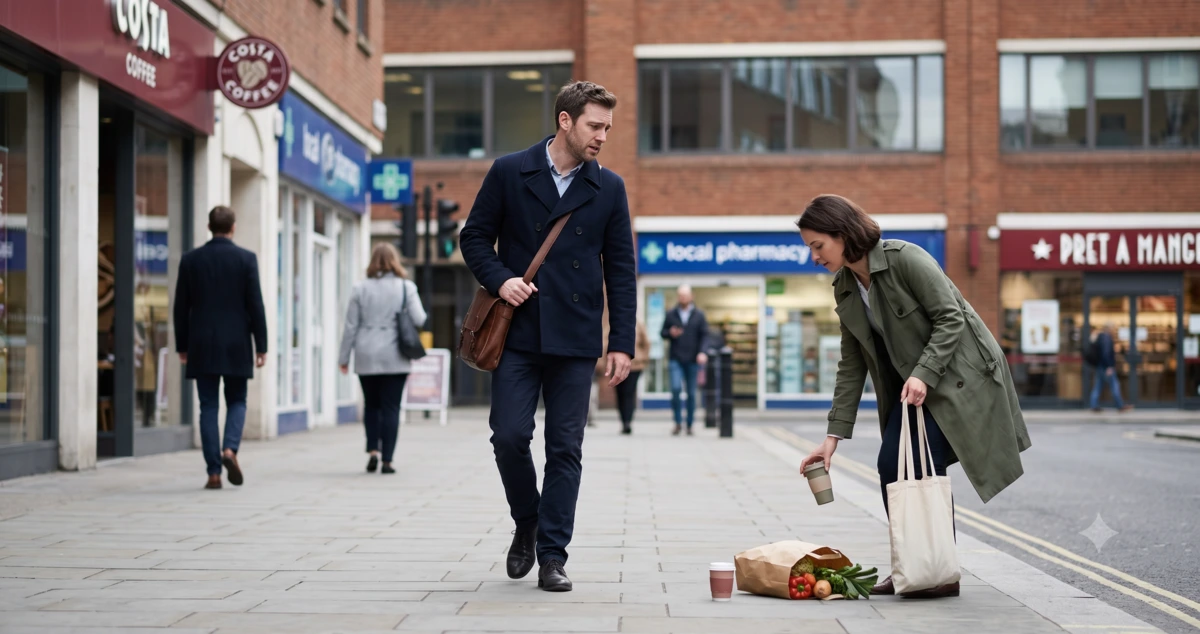

A woman drops a bag of groceries on a crowded pavement.
An orange rolls toward the curb. A carton lands on its side. People notice.
One person is late for work. Another is looking at a phone. Someone slows down for half a second, seems to consider helping, then keeps walking.
Finally, a stranger stops.
If you witnessed only the people who walked past, the scene might confirm something you already suspected: people do not seem as kind as they used to be.
But what exactly would you have observed?
A decline in compassion?
A city full of selfish people?
Or several ordinary humans whose attention, time and emotional energy were already occupied?
The distinction matters because kindness is not one behaviour. Holding a door requires almost nothing. Listening patiently to a distressed friend requires attention. Helping a stranger carry something requires time. Caring for someone for months may require money, sleep and major personal sacrifice.
A society can therefore become less patient in small encounters without necessarily becoming less generous in larger ones.
And the evidence suggests something even more surprising: we may be considerably more pessimistic about other people’s kindness than their actual behaviour justifies.
One Rude Encounter Can Outweigh Ten Ordinary Ones
Think about yesterday.
How many strangers behaved normally around you?
Someone probably waited their turn.
A driver stopped at a red light.
A cashier completed a transaction without insulting you.
People walked past without causing trouble.
Perhaps someone held a door, moved aside on a pavement or answered a simple question.
Most of those interactions leave almost no memory.
Now imagine one driver aggressively cutting you off.
That one survives the journey home.
You may tell somebody about it later.
“The roads are full of idiots now.”
This is one reason judging the kindness of an entire society from everyday experience is difficult. Much of cooperative behaviour is so ordinary that we barely register it.
Bad behaviour announces itself.
Routine decency does not.
That imbalance becomes even stronger online. A video of someone screaming at a restaurant worker can circulate to millions of people. Nobody uploads footage titled Man Buys Coffee and Treats Barista Normally.
The internet does not need to invent cruelty to distort our impression of it.
It merely needs to make unusual cruelty easier to see than ordinary cooperation.
Kindness Has Several Different Prices
The word kindness can hide an important distinction.
Some acts are almost free.
You can smile at someone.
Say thank you.
Let another car merge.
Move your bag so somebody can sit down.
Other acts cost something.
You spend twenty minutes helping a lost tourist.
Stay late because a colleague is overwhelmed.
Drive across town when a friend needs help.
Give money to someone struggling.
Care for an ill relative.
The more an act requires time, energy, money, attention or inconvenience, the more someone’s current circumstances may affect whether they perform it.
This gives us a better way to think about exhaustion.
A tired person does not necessarily stop caring.
They may become more selective about which caring behaviours they can afford.
Someone who would normally listen patiently to a friend’s 40-minute phone call may reply, “Can we talk tomorrow?”
A commuter who might usually help with those spilled groceries may keep walking because they are already late picking up a child.
A worker who once volunteered for every extra task may begin saying no after months of overtime.
From the receiving side, these behaviours can feel colder.
From the exhausted person’s side, they may represent triage.
The Evidence Does Not Fit a Simple Story of Declining Kindness
If human generosity were simply disappearing, we might expect broad measures of helping behaviour to show it.
They do not.
The World Happiness Report 2025 examined several forms of benevolent behaviour measured internationally through the Gallup World Poll, including helping strangers, volunteering and donating money.
Its findings challenge the idea that society has simply become more selfish.
In 2024, helping strangers remained about 18% above the 2017–2019 global average, and the broader level of benevolent acts remained more than 10% above pre-pandemic levels across almost all regions.
Perhaps more strikingly, researchers concluded that people systematically underestimate how kind others are. Experiments involving lost wallets found that wallets were returned substantially more often than people expected.
The World Happiness Report’s analysis of kindness and benevolence
That does not prove your neighbourhood is friendlier than it was ten years ago.
Nor does helping a stranger tell us whether people are more patient with customer-service workers or more considerate inside relationships.
“Kindness” is too broad for one statistic to settle the argument.
But these findings make one conclusion difficult to defend: that people everywhere have simply stopped caring about one another.
Something more complicated is happening.
We May Be Living Through a Patience Problem More Than a Compassion Problem
Another set of evidence points toward the pressure people are carrying.
Gallup’s State of the World’s Emotional Health 2025 drew on interviews across 144 countries and areas. Among adults surveyed about the previous day, 39% reported experiencing substantial worry and 37% substantial stress.
Those negative emotions remained well above their levels from a decade earlier.
Yet the same global research found something that does not neatly fit a “people have become terrible” story:
88% said they had been treated with respect the previous day.
That was among the highest levels Gallup had recorded.
Gallup’s State of the World’s Emotional Health 2025
So widespread emotional strain and widespread respectful treatment can coexist.
People can be worried and decent.
Stressed and helpful.
Overloaded and still capable of generosity.
But stress may make that generosity less consistent.
That distinction could explain a great deal of what people notice in everyday life.
Perhaps compassion has not disappeared as rapidly as available patience has.
Exhaustion Changes the Threshold for Helping
Imagine you are carrying an empty backpack.
Someone asks you to hold another small bag.
Easy.
Now imagine your backpack already weighs twenty kilograms.
The second bag has not changed.
Your capacity has.
Emotional demands can work similarly.
The colleague asking “Can I talk to you for a minute?” does not know that you slept four hours, argued with your partner before work, have a parent awaiting medical results and are worried about next month’s rent.
Their request may be completely reasonable.
Your ability to respond warmly may still be reduced.
None of this excuses cruelty.
Exhaustion does not make humiliating an employee acceptable. Financial stress does not justify screaming at a spouse. Lack of sleep does not remove responsibility for apologising after treating someone badly.
But explanations and excuses are different things.
If we want to understand whether people have become less kind, hidden capacity matters.
Someone can possess compassionate values while temporarily failing to express them well.
The Behaviour You See May Not Reveal the Motive You Imagine
A stranger does not give up their seat.
Selfish?
Perhaps.
Or perhaps they have an injury you cannot see.
A friend does not answer your message for two days.
Uncaring?
Possibly.
Or overwhelmed.
Someone declines to lend you money.
Ungenerous?
Maybe.
Or they are quietly struggling themselves.
This does not mean we should invent sympathetic explanations for every person who treats us badly.
Sometimes someone really is inconsiderate.
The point is that behaviour is visible while motive and capacity are mostly hidden.
Our minds have to fill in the missing information.
And when society already feels harsh, we may increasingly fill it in negatively.
“He ignored me” becomes “people don’t care anymore.”
“One cashier was rude” becomes “customer service has disappeared.”
“A teenager didn’t offer their seat” becomes “young people have no manners.”
Personal experiences can reveal something about our environment.
They become much less reliable when converted into conclusions about millions of people’s moral character.
There Is Another Kind of Kindness We Often Fail to Count
Suppose two adults each spend five hours helping other people.
One volunteers at a food bank.
The other takes an elderly parent to medical appointments, buys groceries for them and fixes something around their home.
Which person contributed more kindness to society?
There is no sensible way to answer from that information alone.
Yet some caring work is much more visible than other caring work.
Volunteering is counted.
Donations receive receipts.
Organised charity can appear in surveys and annual reports.
Private care inside families and friendships often disappears from public measurement.
Someone may look uninvolved in their “community” while spending enormous amounts of time supporting children, parents, siblings, neighbours or friends.
This is especially important when asking whether people are less kind than previous generations.
The form of helping can change without the underlying willingness to care disappearing.
A person who never joins a community organisation may be the person everyone in their family calls during an emergency.
Modern Life May Have Made Kindness More Scheduled
Older forms of community life sometimes created unavoidable contact.
People knew neighbours because they saw them repeatedly.
Coworkers spoke because they shared the same physical room.
Families lived closer.
Shops were smaller.
People returned to the same local businesses.
More of life now allows us to move efficiently without interacting much.
Order food without speaking.
Use self-checkout.
Work remotely.
Message instead of visiting.
Wear headphones while commuting.
Ask an app instead of asking a stranger for directions.
None of those things is inherently antisocial. Many are extremely useful.
But they reduce the number of small moments in which spontaneous kindness can occur.
If nobody asks you for directions because everyone has maps on their phone, you have lost one opportunity to help a stranger.
If groceries arrive at your door, you have fewer conversations with the local shopkeeper.
If you work from home, you may no longer notice that the person at the next desk looks exhausted.
A society can therefore feel less socially warm without its members consciously deciding to become less compassionate.
The architecture of daily life matters.
Phones Can Remove the Empty Spaces Where We Used to Notice People
Return to the stranger with the dropped groceries.
A person walking beside them may once have been looking around.
Now they may be looking at a screen.
They are physically present but attentively somewhere else.
That difference sounds small, yet many acts of kindness begin with something extremely basic:
noticing.
You cannot offer someone a seat if you never notice they are struggling.
You cannot smile back at the cashier if you are reading a message.
You cannot start a conversation with the lonely person beside you if both of you are wearing headphones.
This does not mean phones have made people selfish.
They compete for a resource kindness often requires before generosity even begins: attention.
The same attention problem appears online in a different form. Feeds repeatedly expose us to strangers’ successes, arguments, disasters and opinions, which can reshape our perception of normal life. We explored one side of that effect in Does Social Media Comparison Make People Feel Behind in Life?.
Digital life can therefore make other people simultaneously more visible and easier to overlook.
Public Cruelty Has Become Easier to Witness
There is another reason society can feel harsher even if everyday kindness has not collapsed.
We now watch people behave badly in places we never previously entered.
A confrontation in a shop thousands of miles away appears on your phone.
A cruel school incident is recorded.
An offensive comment is screenshotted.
A stranger’s worst ten seconds can become international entertainment.
Sometimes this visibility performs a valuable function. Wrongdoing that would once have been ignored can now be documented.
But repeated exposure comes with a psychological cost.
You are no longer judging human behaviour from the people physically around you.
You are judging it partly from an algorithmically selected collection of emotionally intense incidents involving millions of strangers.
If you watch twenty videos of people behaving terribly this week, you have genuinely witnessed twenty examples of terrible behaviour.
What you do not know is the denominator.
Twenty out of how many ordinary interactions?
Without that denominator, visibility can easily be mistaken for prevalence.
The same problem appears when online accountability becomes entertainment, which is why the debate over whether public shaming has gone too far is partly a debate about what happens when someone’s wrongdoing becomes content for an audience.
Small Kindness May Be More Important Than It Looks
Grand acts are easy to celebrate.
Someone raises thousands for charity.
A stranger performs a dramatic rescue.
A community rallies around a family after disaster.
But much of what makes society livable is much less impressive.
A receptionist explaining something twice without making the person feel stupid.
A driver leaving space for another car.
Someone putting a shopping cart where it belongs.
A colleague quietly fixing another person’s mistake without humiliating them.
A teenager helping an older person use a ticket machine.
A neighbour taking in a parcel.
A customer saying, “Don’t worry about it,” when a new employee makes a harmless mistake.
These acts rarely become stories precisely because nothing dramatic happens afterward.
That may be one of kindness’s strange disadvantages as a social signal.
When it works, life simply continues.
The Repair Test Tells Us More Than the Bad Moment
Suppose somebody snaps at you.
Was it exhaustion or unkindness?
The moment itself may not tell you.
What happens afterward often tells you more.
“I was rude earlier. You didn’t deserve that.”
That suggests one thing.
“You’re too sensitive. Deal with it.”
That suggests another.
People under pressure will fail occasionally. No realistic standard of kindness can require permanent patience.
What matters is whether someone notices harm after their capacity returns.
Do they repair it?
Do they apologise without making the apology another accusation?
Do they adjust their behaviour?
Or does “I’m stressed” become a permanent licence to treat everyone badly?
This gives us a useful distinction.
Exhaustion can explain a temporary reduction in kindness. It becomes less convincing when the same behaviour is repeated indefinitely without responsibility or repair.
Kindness Also Depends on What We Think Other People Are Like
Suppose you believe most strangers are selfish.
You are less likely to ask one for help.
You may be less likely to start a friendly conversation.
You become more guarded.
The other person experiences your guardedness and responds cautiously.
Now both of you leave with slightly more evidence that strangers are cold.
Expectations can therefore influence the social environment we later use as evidence for those expectations.
This is why the World Happiness Report’s finding that people underestimate others’ benevolence matters beyond academic curiosity.
If we systematically expect less kindness than people are actually willing to provide, pessimism itself may discourage some of the interactions through which we would discover that our assumptions were wrong.
Kindness is not just something individuals possess.
It can be encouraged—or suppressed—by what people expect from one another.
A Better Way to Ask Whether Someone Is Becoming Less Kind
Rather than judging kindness from one behaviour, look for change across several kinds of situations.
Has the person become less considerate when kindness costs almost nothing?
Do they still help when there is genuine need?
Are they withdrawing from everyone or only protecting themselves from demands they cannot currently meet?
Do they show concern even when they cannot provide practical help?
When they hurt someone, do they attempt repair?
Do they behave warmly toward people who can do nothing for them?
That last question can be especially revealing.
Kindness toward a boss, customer or romantic interest can carry rewards.
Kindness toward a cleaner, delivery worker, elderly stranger or new employee may reveal something different.
Character becomes easier to see when there is little advantage in performing it.
So, Are People Becoming Less Kind?
The broad evidence does not support a simple story in which human generosity is disappearing.
People still help strangers. They still volunteer. They still give. Most people around the world report being treated with respect.
At the same time, substantial numbers of people are living with worry, stress and other forms of emotional strain.
Those two facts can exist together.
Perhaps the more accurate description of modern life is that kindness remains widespread while people’s capacity to express it consistently is under pressure.
There may also be a perception problem.
Cruelty is memorable.
Outrage is shareable.
Ordinary decency is quiet.
And some caring work happens where nobody is counting it.
None of this means concerns about declining civility should be dismissed. If people become more impatient, less attentive or less willing to engage with strangers, those changes matter even if charitable giving remains strong.
But “people are worse now” may be too crude a conclusion.
A society can become more distracted without becoming more selfish.
More exhausted without becoming less compassionate.
More visibly hostile online while remaining surprisingly cooperative offline.
Perhaps the question is not only whether kindness is disappearing.
It is whether the conditions of modern life make kindness harder to notice, harder to perform consistently, or both.
Think About the Last Week, Not Humanity in General
Before voting, ignore headlines for a moment.
Think about the people you actually encountered during the last seven days.
Who was rude?
Who surprised you by helping?
How many ordinary considerate acts did you barely notice because nothing went wrong?
And when someone seemed cold, did you have enough information to know whether they did not care—or simply had very little left to give?
Cast your vote based on what you have genuinely observed.
Then share the behaviour that has changed your mind most. Perhaps the most interesting answers will not tell us whether humanity has become kinder or crueler, but which kinds of kindness people feel are disappearing—and which ones are still happening quietly all around us.
The Quirky Minds polls reflect the opinions of participating readers. They are informal reader polls and should not be interpreted as scientific surveys or professional psychological advice.