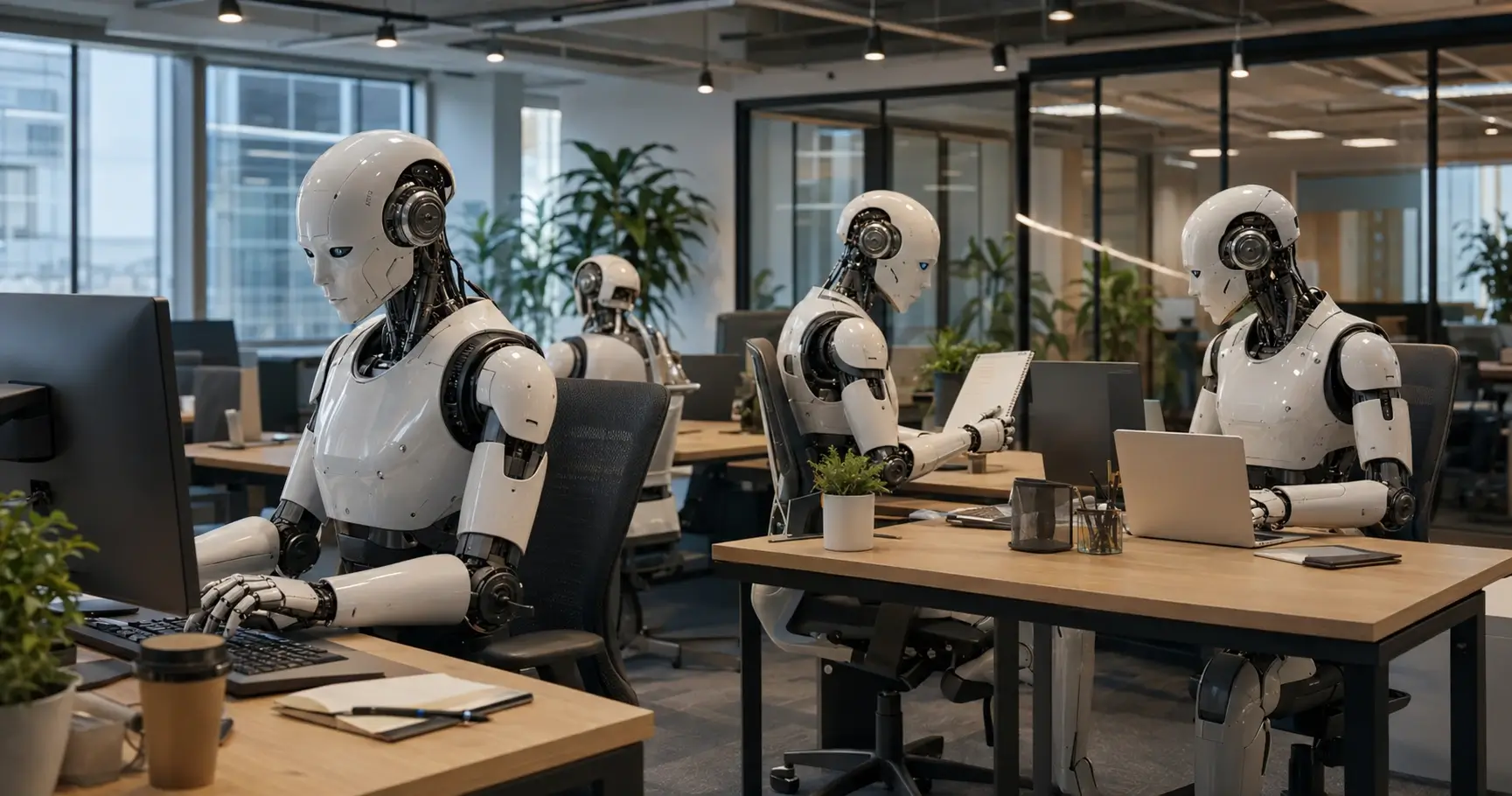

Imagine arriving at work one Monday and finding a new AI assistant built into the software your team already uses.
Nobody is fired.
The company tells employees that AI is there to help with research, emails, reports, customer questions and routine administration. Within months, people are finishing certain tasks faster. When one employee leaves, the company does not immediately replace them. Later, a team that once needed eight people manages with six.
No robot ever “took” anyone’s chair.
Yet the number of jobs changed.
That is one reason the question “Will AI replace your job by 2031?” is more complicated than it first appears. Replacement does not always arrive as a dramatic announcement that a machine can now perform an entire profession. It can arrive through fewer vacancies, smaller teams, redesigned roles, higher output expectations or work being divided differently between people and software.
At the same time, AI can create work, expand demand and make some employees considerably more valuable.
So before predicting whether your job survives, it helps to ask a more precise question:
What would actually have to happen between an AI gaining a capability and your employer deciding that your position is no longer needed?
“AI Can Do My Task” Is Only the First Step
Suppose an AI system can produce a reasonable first draft of something you currently write.
That sounds like automation.
But four separate things still have to happen before it becomes job replacement.
The technology has to perform the task well enough.
Your employer has to trust it enough to use it.
The workflow has to be redesigned around it.
And the productivity gain has to give the employer a reason to reduce hiring or headcount rather than simply produce more work.
Those stages are often blurred together in predictions about the future of employment.
A demonstration showing that AI can perform a task is evidence about technical capability. It does not automatically tell us whether the technology will be cheap, reliable, legally acceptable, easy to integrate or trusted by customers.
Even successful automation does not guarantee fewer jobs.
Imagine an architecture firm that can produce initial design variations twice as quickly. It could employ fewer designers.
Or it could take twice as many projects.
A small business that suddenly gains inexpensive marketing tools might reduce spending on routine freelance work. Another business that previously could not afford professional marketing at all might begin buying services it never purchased before.
Technology changes the cost of doing something. What happens to employment depends partly on what employers and customers do after the cost changes.
That economic step is often missing from the simple “AI can do X, therefore X job disappears” argument.
The Evidence Points More Strongly to Job Transformation Than Mass Disappearance
The most useful large-scale research does not suggest that AI will leave the labour market untouched.
It also does not support the idea that a quarter of the world’s workers are about to become unemployed.
The International Labour Organization’s 2025 global analysis examined nearly 30,000 occupational tasks and estimated that roughly one in four workers worldwide was employed in an occupation with some degree of exposure to generative AI. Only a much smaller share of total employment fell into the highest exposure category.
More importantly, the researchers concluded that transformation is more likely than complete replacement for most occupations, because jobs usually contain tasks that still require human involvement.
“Exposure” is an easily misunderstood word here.
It means AI could potentially perform relevant parts of the work. It does not mean those workers will lose their jobs.
A bookkeeper whose reconciliation work becomes partly automated is exposed.
A designer using generative tools is exposed.
A lawyer whose software can summarise thousands of pages is exposed.
A customer-support employee whose system drafts replies is exposed.
Each person’s occupation may change substantially while the occupation itself continues to exist.
The World Economic Forum’s Future of Jobs Report 2025 points in the same direction: large disruption rather than a simple collapse of employment. Based on employer expectations and broader economic trends, it projected around 170 million jobs created and 92 million displaced by 2030, a net increase of 78 million. Those numbers cover several forces—including AI, demographics, economic changes and the green transition—so they should not be presented as an AI-only forecast. The report also found employers expected AI and information-processing technologies to be among the biggest forces reshaping businesses.
That is a very different future from “AI eliminates work.”
It is a future in which some kinds of work shrink while others expand, and the contents of many surviving jobs change.
Your Job Title May Tell You Less Than You Think
Ask whether AI will replace “accountants” and the question is too broad.
One accountant may spend much of the day entering information, reconciling predictable records and producing standard reports.
Another may investigate unusual transactions, advise clients, interpret complicated rules and defend professional judgments.
The title is the same.
The automation problem is not.
The same applies almost everywhere.
A marketing role may include writing routine product descriptions, interviewing customers, managing agencies, analysing campaigns, persuading executives and deciding where millions of dollars should be spent.
A software developer may write repetitive code, diagnose unfamiliar production failures, discuss poorly defined requirements with clients and decide which technical compromises a business can tolerate.
A teacher may prepare worksheets, explain difficult concepts, manage thirty students, notice when a child has misunderstood something and deal with parents.
AI may reach several pieces of those jobs at very different speeds.
This suggests a better way to think about your own risk:
Do not analyse your occupation first. Analyse your working week.
Which activities consume your hours?
Which could already be accelerated?
Which require access to information an AI system does not have?
Which depend on somebody trusting you, not merely receiving an output?
Which mistakes require a person to stand behind the decision?
Your personal answers may reveal more than a list titled “10 jobs AI will replace.”
Job Loss May Happen Through Vacancies That Never Appear
When people imagine automation, they often picture existing employees being dismissed.
That is only one route.
Suppose a department normally employs 20 people and replaces four or five workers each year because employees retire, resign or move internally.
If AI increases productivity, management may decide that only two replacements are necessary.
Nobody has technically been “replaced by AI.”
But three job opportunities that might previously have existed never reach the careers page.
Repeated across thousands of companies, that kind of change could matter greatly.
It may also make technological disruption difficult for workers to recognize. Employment can shrink gradually through hiring freezes, attrition, outsourcing and reorganised teams rather than one large AI-related layoff.
That creates a particularly important question for younger workers.
What Happens When AI Learns the Work Juniors Used to Learn On?
Many careers have an informal ladder.
A junior worker begins with relatively structured tasks.
They prepare the first draft.
Check the spreadsheet.
Write basic code.
Conduct background research.
Produce routine graphics.
Summarise documents.
Answer straightforward customer questions.
Those assignments generate useful output, but they also serve another purpose: they teach the junior employee how the profession works.
Years later, that person is trusted with ambiguity, judgment and responsibility partly because they learned through simpler work first.
Now imagine AI becomes exceptionally good at that bottom layer.
From an employer’s immediate perspective, automating routine junior work can look efficient.
But a longer-term problem appears: where do tomorrow’s experienced workers come from if fewer people are hired to perform the work through which experience was traditionally acquired?
A company might respond by redesigning training. Junior employees could begin with AI supervision, client contact, verification or more complex tasks earlier in their careers.
It could work.
But that requires deliberate investment.
If employers simply remove entry-level work without replacing its training function, the labour-market consequences could become more significant than the disappearance of any particular task.
This is one reason the AI discussion intersects with the question of whether a university degree still provides enough value for its cost. Education and early career experience are connected: if technology changes the first jobs graduates traditionally enter, students may need to judge qualifications partly by how well they lead into a changing labour market.
The Most Exposed Worker Is Not Necessarily the Least Skilled One
Earlier waves of automation were often associated with factories and routine manual work.
Generative AI disrupted that expectation by performing tasks associated with writing, coding, design, research and administration.
That means education alone does not create immunity.
In fact, highly digitised jobs can be easier for AI systems to interact with precisely because much of the work already exists as text, images, numbers, software or structured information.
A physical job can present a very different challenge.
Repairing a pipe in an unfamiliar century-old building may sound intellectually simpler than summarising a contract. But the plumber has to locate the problem, physically reach it, use tools in an unpredictable environment, avoid damaging surrounding property and adapt when reality does not match the diagram.
The contract already exists as machine-readable text.
Automation difficulty is therefore not a ranking of human intelligence or social importance.
It depends partly on the environment in which work occurs.
The Jobs That Survive May Still Become Harder Jobs
Keeping your job does not necessarily mean AI has had little effect on you.
Imagine that an employee previously prepared four detailed reports each week.
AI allows the first drafts to be produced rapidly.
Management may not cut the job. Instead, the expectation becomes eight or ten reports.
The tedious part has declined.
So has the time available for each assignment.
A productivity tool can remove repetitive work while simultaneously raising the amount of work considered normal.
This has happened with earlier office technologies too. Faster communication did not make workplaces communicate less. Spreadsheets did not eliminate financial analysis. Search engines did not remove research.
Often, technology changes the baseline.
What once looked impressively fast becomes an ordinary expectation.
For workers, that means AI’s effect should not be measured only by employment.
It can affect workload, monitoring, required skills, independence, bargaining power and the speed at which people are expected to deliver.
A person may be significantly affected by AI while remaining fully employed.
Human Accountability May Become More Valuable as AI Output Becomes Cheaper
Suppose an AI system gives a bank an assessment of a loan applicant.
Who explains a rejection?
Suppose it recommends a medical treatment.
Who is accountable if the recommendation is wrong?
Suppose it produces a legal argument.
Who signs the document?
Suppose an AI-created financial report contains a serious mistake.
Who tells the board that the figures are trustworthy?
As AI makes certain outputs cheaper to produce, responsibility for those outputs does not automatically disappear.
In some occupations, the scarce resource may eventually become less about producing information and more about deciding whether that information deserves to be acted upon.
That distinction matters particularly in high-stakes work.
We explored the same issue from the public’s perspective in Would You Trust AI to Make a Life-Changing Decision for You?. People may accept extensive AI assistance while still wanting an identifiable human being to remain responsible for important decisions.
For workers, being close to that point of responsibility can matter.
The employee whose only contribution is producing a standard first draft may face greater pressure than the employee who understands the client, questions the assumptions, catches the unusual case and accepts responsibility for the final outcome.
“Creative Work Is Safe” Is Not a Reliable Rule Either
Creativity is often listed among the abilities that will protect workers from AI.
The claim needs qualification.
AI systems already produce illustrations, advertising copy, video, music, software concepts and design variations. The ILO’s updated analysis specifically noted increasing exposure in some media- and web-related occupations as generative systems improved across text, image, voice and video.
The more useful distinction may be between generating material and having a reason why this particular material should exist.
A company may need 100 variations of an advertisement.
AI is well suited to generating options.
Deciding which message fits the brand, which claim creates legal risk, what customers currently care about, how a campaign fits a broader strategy and why a particular creative direction deserves investment involves a different layer of work.
Consumer preference can also affect employment.
If people consider two products equivalent and one can be produced much more cheaply with AI, price pressure is obvious.
But some buyers care about authorship, craft, personal expertise or direct human involvement. That is why the question of whether people would pay more for human-created content instead of an AI-produced alternative is not merely philosophical. Customer preference can help determine whether automation reduces demand for human labour or changes what people are willing to pay humans to do.
The Safer Skill Is Not Simply “Knowing How to Use AI”
“Learn AI” has become standard career advice.
It is useful, but incomplete.
If an AI tool becomes as common as email or spreadsheets, basic operation of it may eventually stop being a special advantage.
Knowing how to type instructions into a widely available system will not necessarily protect a career if everyone else can do the same.
The more durable advantage is likely to come from combining AI with something that remains scarce.
That might be:
- deep knowledge of a particular industry;
- access to customers and the ability to understand what they actually need;
- judgment developed through experience;
- the ability to verify whether an answer is plausible;
- responsibility for high-stakes outcomes;
- practical skill in a physical environment;
- persuasion, negotiation or leadership;
- trusted relationships;
- knowledge that is not easily available in public training data;
- the ability to turn a vague problem into a useful question.
Consider two employees using the same AI system.
One asks it to create whatever management requests.
The other understands the business well enough to notice that management is asking the wrong question.
The second employee’s advantage is not prompting.
It is judgment.
A Five-Minute Test for Your Own Job
Rather than searching for a prediction about your job title, take the work you actually perform and ask five questions.
How much of it already happens entirely on a screen?
Digital work is often easier for software to access than work requiring physical interaction with an unpredictable environment.
How repetitive is the input and output?
Tasks become easier to automate when similar information repeatedly produces similar deliverables.
How easy is the work to check?
Automation is more attractive when a company can quickly determine whether the output is correct. A mistake that might remain hidden for months creates a different level of risk.
Who carries responsibility if something goes wrong?
Where law, safety, money, reputation or human welfare are at stake, organizations may still require accountable people even when AI performs much of the analysis.
If your work becomes dramatically cheaper, will your employer need fewer people—or buy much more of it?
This final question is often the most overlooked.
If demand barely changes, higher productivity can reduce staffing requirements.
If cheaper production creates much greater demand, productivity can support more business and potentially more employment.
No single answer determines your future. Together, however, they give a more useful picture than the occupation name on your résumé.
The Person Most at Risk May Be the One Whose Job Stops Changing
There is a temptation to respond to uncertainty by waiting for clarity.
Perhaps AI will plateau.
Perhaps employers will decide it is unreliable.
Perhaps regulations will slow adoption.
Perhaps your particular industry will change much less than predicted.
Any of those things could happen.
Predictions about technology routinely miss both the speed and the direction of change.
But waiting for certainty creates its own risk.
If AI performs only 20% of your current work by 2031, the remaining 80% may become more important precisely because the automated portion became cheap.
The worker who learns where that remaining value sits has an advantage.
That does not necessarily mean becoming an AI engineer.
An electrician does not need to build a language model.
A teacher does not need to train one.
A manager does not need to understand every technical detail of neural networks.
They need to understand how the technology changes their particular work, where it fails, where it helps and what their organization will still pay a person to be responsible for.
So, Will AI Replace Your Job by 2031?
It might.
Some jobs will disappear, and it would be misleading to pretend every worker can simply “adapt” without cost. Automation can create painful transitions, particularly when a person’s existing skills are highly specialized and local opportunities are limited.
But complete occupational disappearance is only one possible outcome.
Your job might remain while half its tasks change.
Your profession might grow while requiring fewer beginners.
Your employer might keep the same number of people and expect much more output.
AI might remove the least enjoyable part of your work.
It might make your expertise more valuable because somebody still needs to judge the machine’s output.
Or it may lower the value of something you spent years learning to produce.
By 2031, the most revealing workplace question may therefore not be:
“Did AI take my job?”
It may be:
“Which part of my old job is the market still paying a human to do?”
That is the part worth identifying before everyone else does.
Cast Your Vote With Your Actual Work in Mind
Think about the job you perform rather than the profession printed on your business card.
Which part of your working week could realistically be automated today?
Which part would you happily hand over?
And if AI made you twice as productive, would your employer use that productivity to grow the business—or decide it needed fewer people?
Cast your vote based on what you expect by 2031, then explain which part of your work made you choose that answer. Readers doing very different jobs may discover that the dividing line is not simply between “safe careers” and “unsafe careers,” but between very different combinations of tasks, responsibility, demand and human trust.
The Quirky Minds polls reflect the opinions of participating readers. They are informal reader polls and should not be interpreted as scientific employment forecasts or individual career advice.